
How Shopstar used customer support software to streamline support without adding headcount
If you've ever watched your order volume climb while your support inbox spirals out of control alongside it, this story will feel familiar. Shopstar, a growing UK e-commerce brand, consolidated four scattered support channels (email, a separate live chat widget, Instagram DMs, and a spreadsheet used for manual tracking) into one shared inbox powered by customer support software with flat-rate pricing. The change gave their three-person team full visibility into every customer conversation, brought first-response times down noticeably, and let them handle a heavier ticket load without adding a permanent agent to headcount. They did bring in temporary seasonal help during a product launch later on, which we'll get to, but that's different from hiring a new full-time support person.
A quick note on the numbers in this piece: Shopstar asked us not to publish its exact internal figures, so where we reference response times or ticket volumes below, we've labelled them as illustrative and based on patterns we see across similarly sized e-commerce teams making the same switch. We'd rather be upfront about that than dress up rounded estimates as precise data.
No big support department. No six-figure software budget. Just one clear workflow change that solved a problem that was starting to feel unsolvable. Let's walk through what actually happened.

The growth problem: more orders, more customer support questions
Shopstar's growth was the good kind of problem to have, on paper. Orders kept climbing month over month, which is exactly what every e-commerce brand hopes for. But here's the thing about growth that doesn't show up in the sales dashboard: support tickets scale right alongside orders, and usually faster than you'd expect, especially around UK peak periods such as Black Friday and the Boxing Day sales rush.
The team behind Shopstar wasn't a dedicated support department with shift schedules and escalation tiers. It was three people, each wearing several hats, trying to keep the lights on while also answering "where's my order?" messages between everything else on their plate. That's a common setup for growing e-commerce brands, and it works fine when volume is low. It stops working the moment volume isn't.
The real issue wasn't just the number of messages coming in. It was where they were coming in from. Email. A live chat widget on the website. Instagram DMs from customers who'd rather message there than send an email. A spreadsheet someone updated, sometimes, to track which tickets still needed a reply. Each channel lived in its own little world, checked separately, often by whoever happened to be free at the time.
On a representative busy week, roughly the kind Shopstar described to us, the team might see several hundred messages land across those four places. With no shared view, nobody had a full picture of what was open, what had already been answered, and what had quietly fallen through the cracks. That last part is the one that stings. You usually don't find out about a missed message until a customer mentions it, annoyed, in a follow-up, often asking why nobody has got back to them within what UK shoppers now expect as a same-day response.
Why Shopstar's multiple support tools were no longer working
Here's what was actually happening behind the scenes. If you're running customer support across more than one channel right now, some of this will probably sound familiar:
- Switching between inboxes meant duplicated replies and missed messages. One team member would answer an email, not realising someone else had already replied via chat to the same customer about the same delivery query.
- No shared visibility meant inconsistent answers. Two people might tell the same customer two different things about a return policy simply because neither could see what the other had already said, which is a particularly awkward look given UK customers' clear expectations under consumer rights rules around returns.
- Per-seat pricing on their old help desk software made scaling expensive. Bringing in extra help during a busy sales period meant a bigger monthly bill, which made the team hesitant to get support even when they clearly needed it.
- Reporting was entirely manual, propped up by that tracking spreadsheet. Nobody had a real sense of average response times, peak hours, or where bottlenecks were forming because the spreadsheet was only updated when someone remembered to do it.
- Onboarding new tools took days, not minutes, which is a real problem when you need speed right when things get hectic, not three days later once the setup is finally finished.
Individually, none of these issues felt like a crisis. Together, they meant the team was spending more energy managing tools than actually helping customers. That's the tipping point a lot of growing brands hit eventually: the setup that worked fine at a smaller scale starts actively working against you once volume picks up.
How Shopstar consolidated support into one shared inbox
The fix wasn't more people. It was fewer tools, pulled together into one piece of customer support software everyone could see at once. Here's roughly how Shopstar made the switch, and how each of the original four channels was handled:
- Routed all email support through a single ticketing system, replacing the shared email login that three people were logging into separately and hoping nobody stepped on anyone else's replies.
- Connected the existing live chat widget directly into the same inbox as email tickets, rather than replacing it outright. No more checking a separate chat dashboard; one shared inbox, two channels combined.
- Integrated Instagram DMs into the shared inbox so messages from social arrived alongside email and chat instead of living on someone's phone. This was the trickiest piece to set up and took a bit of extra configuration, but it closed the biggest visibility gap.
- Retired the tracking spreadsheet entirely, since tagging and status tracking inside the shared inbox did the same job automatically and in real time.
- Used tagging and filtering to sort order issues, shipping questions, and returns at a glance, so the team could filter by category and tackle similar tickets in batches instead of scrolling through everything.
- Added internal notes so team members could hand off conversations without calling or messaging each other first. If someone needed to step away mid-conversation, they could leave context on the ticket for whoever picked it up next.
- Switched to flat-rate pricing, so bringing on seasonal support during peak sales periods didn't mean a bigger bill. This turned out to be one of the more underrated parts of the change, and it later let them add temporary help for a product launch without another budget conversation.
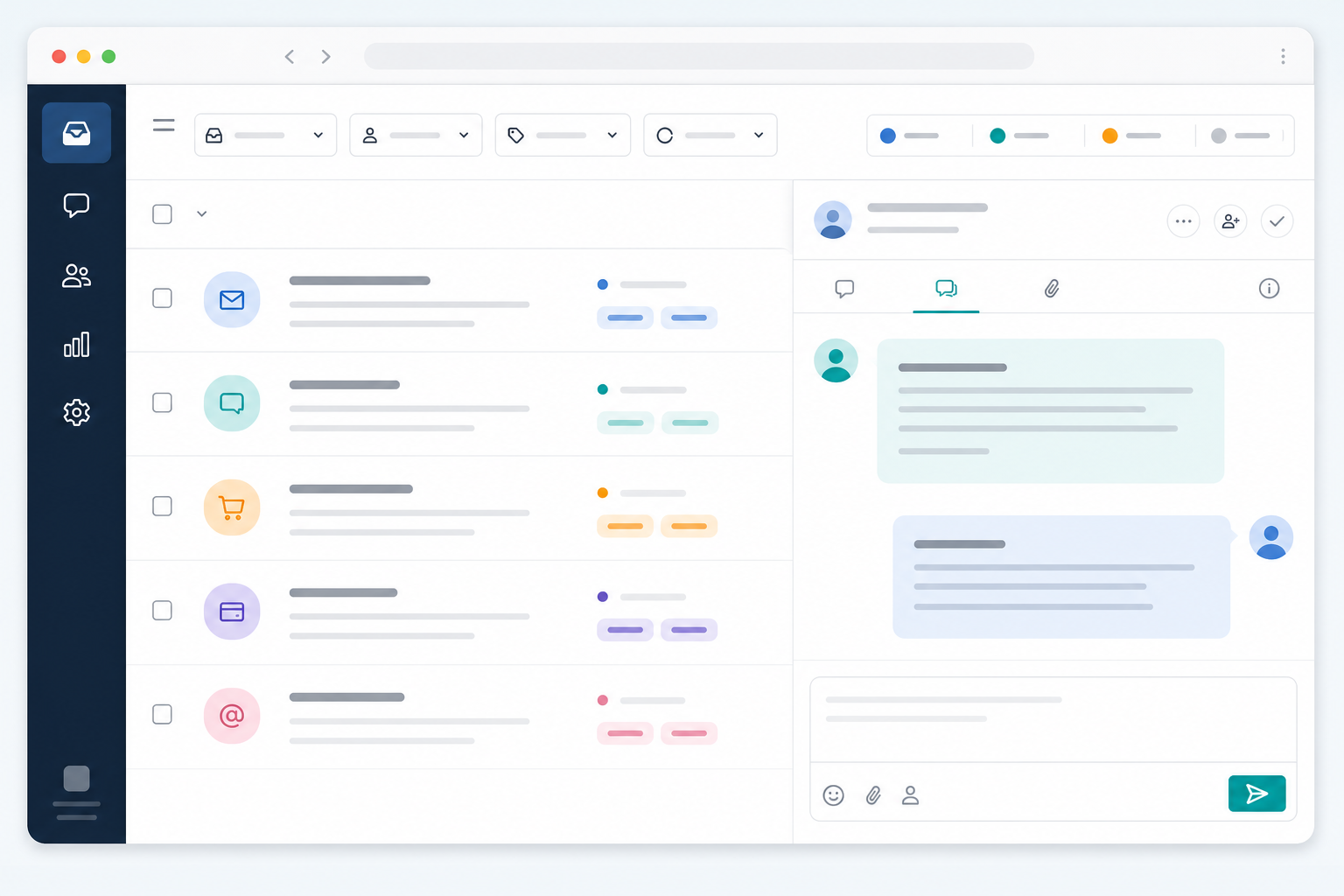
What's genuinely useful about this approach is how unglamorous it is. There's no clever hack or secret automation trick. It's customer support software doing the job it's meant to do: giving a small team a single place to work from instead of four. The hard part isn't understanding the idea; it's making the switch instead of limping along with the status quo.
Setup speed mattered here too. Shopstar wasn't in a position to spend a week on onboarding calls and configuration. They needed something that worked almost immediately, which is increasingly the norm for help desk software built for smaller teams rather than enterprise support departments with dedicated IT resources.
Results: faster responses and more team capacity
Once tickets stopped getting lost between tools, the team reported a noticeable drop in average first-response time within the first month or so of switching. Again, these are illustrative figures based on the pattern Shopstar described to us, not exact published metrics, but they give a realistic sense of scale:
| Metric | Before consolidation | After consolidation (illustrative) |
|---|---|---|
| Average first response time | Roughly 8–10 hours | Roughly 2–3 hours |
| Weekly ticket volume handled | ~250 | ~400+ |
| Channels checked separately | 4 | 1 |
| Permanent support headcount | 3 | 3 (plus temporary seasonal help during launches) |
That drop makes sense when you think about it: a large chunk of slow responses weren't happening because the team was overwhelmed with raw workload. They were happening because messages were scattered across four places and nobody had a clean way to see what still needed attention.
With everything in one shared inbox, the team could see at a glance which conversations were untouched, which were tagged for follow-up, and which were simply waiting on a customer reply. One team member described it to us as the difference between constantly mentally tracking "did I answer that DM?" and glancing at a screen where the answer was already sitting there.

Reporting turned out to be a bigger deal than the team expected. Once response times and ticket volume were being tracked instead of guessed at, they could spot slow periods before they turned into a full backlog. That's a meaningful shift from reactive firefighting towards something closer to actual planning, though it's worth saying plainly: a shared inbox didn't eliminate busy periods; it just made them visible early enough to plan around.
Because pricing didn't scale with headcount, bringing on temporary support during a product launch wasn't a budget conversation anymore. It's worth being precise here: Shopstar didn't need to hire a new permanent agent to handle the extra volume day to day, but they did bring in short-term seasonal help when a specific launch spiked demand beyond what three people could reasonably cover. Flat-rate pricing made that flexibility possible without recalculating software costs every time.
Lessons for other growing UK e-commerce brands
If there's a bigger takeaway here, it's this: volume growth often exposes tool fragmentation before it exposes an actual staffing problem. It's tempting to look at a growing backlog and think, "we need to hire," when what you may actually need is a workflow that doesn't scatter your team's attention across four different logins. That said, this isn't a universal fix, and it's worth treating it as a decision framework rather than a guarantee.
- Check whether you're drowning in volume or disorganisation before hiring. A shared inbox can often solve the second problem. It generally can't solve the first, so if your current team genuinely can't keep up even with full visibility, hiring is still probably the right call.
- Flat-rate pricing removes the penalty for scaling support access up or down. Seasonal demand is normal in UK e-commerce, particularly around Black Friday, Christmas, and January returns. Your software costs shouldn't punish you for responding to it.
- Setup speed matters more than feature lists when you're mid-crunch. It's easy to get seduced by a long feature list during a calm planning period. When you're underwater, what matters is getting a working system live in minutes, not weeks.
- Visibility into team performance data turns guesswork into decisions, but only if you act on it. Once you can see response times and ticket volume clearly, staffing decisions can be based on numbers instead of vibes, provided someone reviews the reporting regularly.
- Don't wait for a full crisis to make the switch. Shopstar made this change while things were manageable but clearly trending in the wrong direction. That's a better time to fix a workflow than after you've already lost customers to slow responses.
The pattern here isn't unique to Shopstar. We've seen similar dynamics play out at other growing brands: support feels chaotic not because the team is too small, but because the tools aren't talking to each other. Fixing the tools doesn't guarantee results on this scale for every team, but for teams in a similar position, it's often the first thing worth trying before assuming the answer is more hires.
FAQ: customer support software for growing e-commerce teams
How do fast-growing e-commerce stores keep support quality high without hiring constantly?
Often it's less about adding people and more about giving the existing team one clear place to work from. Consolidating email, chat, and other channels into a shared inbox, a core part of modern customer support software, means fewer things fall through the cracks. Tagging and filtering also help small teams prioritise what needs attention first. This won't replace hiring if your team is genuinely understaffed for the volume you're handling, but it can provide real breathing room before that becomes necessary.
What changes when a brand consolidates its support tools?
The biggest shift is visibility. Instead of checking three or four separate logins, the whole team can see every open conversation in one place, with internal notes replacing much of the back-and-forth that used to happen over Slack or in person. Reporting also becomes more realistic because response times and ticket volume live in one system instead of being scattered across a spreadsheet nobody kept up to date.
What results can a brand realistically expect from switching customer support software?
Results vary by team and starting point, but many teams see faster first-response times fairly quickly after consolidation because fewer messages get missed or duplicated. Over a few months, teams often gain a clearer view of their actual ticket volume and peak periods, which makes staffing and seasonal planning less of a guessing game. Track your own before-and-after numbers rather than assuming a specific percentage improvement, since the size of the gain depends heavily on how fragmented your starting setup was.
Is flat-rate pricing better than per-seat pricing for a small e-commerce support team?
For teams that need to flex up during sales events or UK seasonal peaks such as Black Friday and Christmas, flat-rate pricing removes the cost penalty of adding temporary help. Per-seat models can discourage bringing in extra hands exactly when you need them most. That said, if your team size is genuinely stable year-round with no seasonal spikes, the difference between pricing models matters less, and it's worth comparing actual costs for your specific team size either way.