
Flat-rate pricing vs usage-based help desk software: what costs less as your support team grows?
If you're growing your support team, or you expect conversation volume to swing throughout the year, flat-rate pricing usually wins on predictability. For a lot of growing or high-volume teams, it also ends up cheaper overall once you factor in added agents, overage fees, and optional extras.
Usage-based and per-seat billing can look cheap at first glance, but the moment you add agents or hit a busy season, your bill can climb in ways that are genuinely hard to forecast. Flat-rate models, like Sonny's plan at roughly £16 a month (excluding VAT) for unlimited agents, take most of that guesswork off the table. 💸
I've talked to a lot of support teams who signed up for a help desk tool because the starter price looked brilliant, only to get that sinking feeling a few months later when the invoice showed up. If that's you right now, staring at a bill that crept up without anyone really "deciding" to spend more, you're not alone. Let's walk through what these different pricing models actually mean and how to figure out which one really costs less for your team.
One quick note before we get into it: pricing from named competitors changes often and isn't always laid out publicly in a way you can easily verify. Where I mention competitor pricing below, I'm using rounded, illustrative figures based on common patterns in the industry, not a live quote from any specific vendor. Always check current pricing pages yourself before you budget.
Understanding usage-based and per-seat billing
Before we compare costs, it helps to be precise about what we're actually comparing. "Usage-based" and "per-seat" pricing get used interchangeably a lot, and they're not quite the same thing.
Per-seat pricing charges you per agent, per month, no matter how many conversations that agent handles. If your plan costs £31 per seat and you have five agents, you're paying £155 a month. Add a sixth agent and you're at £186, whether that person handles ten conversations a day or a hundred.
Usage-based pricing charges you for what you consume, typically tickets, conversations, contacts, or increasingly, AI-powered resolutions. You might pay a base platform fee that covers a set number of tickets, then an overage charge once you go past it. Your headcount doesn't drive the price directly; your volume does.
Hybrid pricing combines both: a per-agent charge plus usage caps and overage fees stacked on top. This is getting more common as vendors add AI features, since a lot of them now charge separately for each automated resolution on top of regular seat or usage fees.
Here's why all three can look tempting at first. When you're a five-person team handling a modest number of conversations, an entry price of £15 or £31 per seat looks fantastic. And for a moment, it really is that cheap.

But here's where it gets tricky. That low entry price is usually just the starting line. Plenty of usage-based and hybrid platforms cap the number of tickets or conversations included, then charge overage fees once you cross that limit. Some tack on AI-related charges too, billing per automated resolution.
To make this concrete: imagine a hypothetical plan with a £23 base fee covering 500 tickets a month, then £0.08 per ticket after that, plus £0.79 per AI-resolved query. In a steady month with 1,000 tickets, that's £23 plus £40 in overage, so £63 total. In a busy month with 5,000 tickets, the overage alone jumps to £360, pushing the bill to £383 before you've paid for a single human agent's seat.
These numbers are illustrative rather than pulled from one named vendor, but the mechanics they describe show up all over the help desk software category.
How per-agent pricing changes as your team grows
Per-seat pricing behaves differently from usage-based billing. Picture a five-person support team that grows to twelve people over a year, a completely normal path for a scaling SaaS or e-commerce brand. Under a per-agent model priced at around £31 per seat per month, that team's monthly software bill goes from £155 to £372. It more than doubles, and nothing about the tool itself has changed.
Nobody added features. The team just grew, and the seat-based pricing grew right along with it.
Understanding flat-rate pricing for help desk software
Flat-rate pricing works differently again. Instead of charging based on agent count or conversation volume, you pay one fixed monthly amount for the core product. It doesn't matter if you have three agents or thirty, or whether you handle 200 conversations or 20,000, as long as you're within the plan's fair-use terms.
This is how Sonny's core plan works: around £16 a month (excluding VAT, so check the exact rate for your billing region), with unlimited agents and unlimited conversations baked into that base price. No seat multiplier, no conversation cap triggering overage charges on the core inbox functionality.
Worth being precise about scope here, because "flat-rate" doesn't mean every conceivable feature is bundled in forever. The base plan covers the shared inbox, live chat widget, email-to-ticket forwarding, internal notes, tagging, and reporting. Optional add-ons, like an AI-powered copilot trained on your company documents, are priced separately rather than folded into the £16 base rate.
That's a reasonable trade-off as long as it's stated clearly. Check current add-on pricing directly on the vendor's website before you commit, since these things do change.
Who benefits most from unlimited-agent pricing?
Growing teams benefit because they can add agents without recalculating their software budget every time they make a hire. Seasonal businesses, like e-commerce brands that see conversation volume spike during big sales events, benefit too, because those spikes don't touch the core help desk software bill.
Flat-rate pricing vs usage-based billing: which is more predictable?
There's a genuine argument for usage-based billing, and I don't want to wave it away. In theory, you only pay for what you use. If your team is small, your conversation volume is low and genuinely stable, and you've checked that you won't hit overage tiers, a usage-based plan might actually come out cheaper on paper.
But finance teams already know predictability has value on its own. When you're building a budget or forecasting runway, a software line item that never moves is often worth more than one that's theoretically cheaper on average but could spike without warning. Flat-rate pricing lets you plan with more confidence.
Usage-based flexibility tends to break down in three common situations: when your team is growing, when your business is seasonal, and when you hit a support spike, like a product bug or a viral moment flooding your inbox. In each case, a usage-based or per-seat structure adds cost right when you're already under pressure.
That said, some usage-based plans include generous caps, annual commitment discounts, or predictable tiering that soften this effect. Check the specific terms rather than assuming the worst.
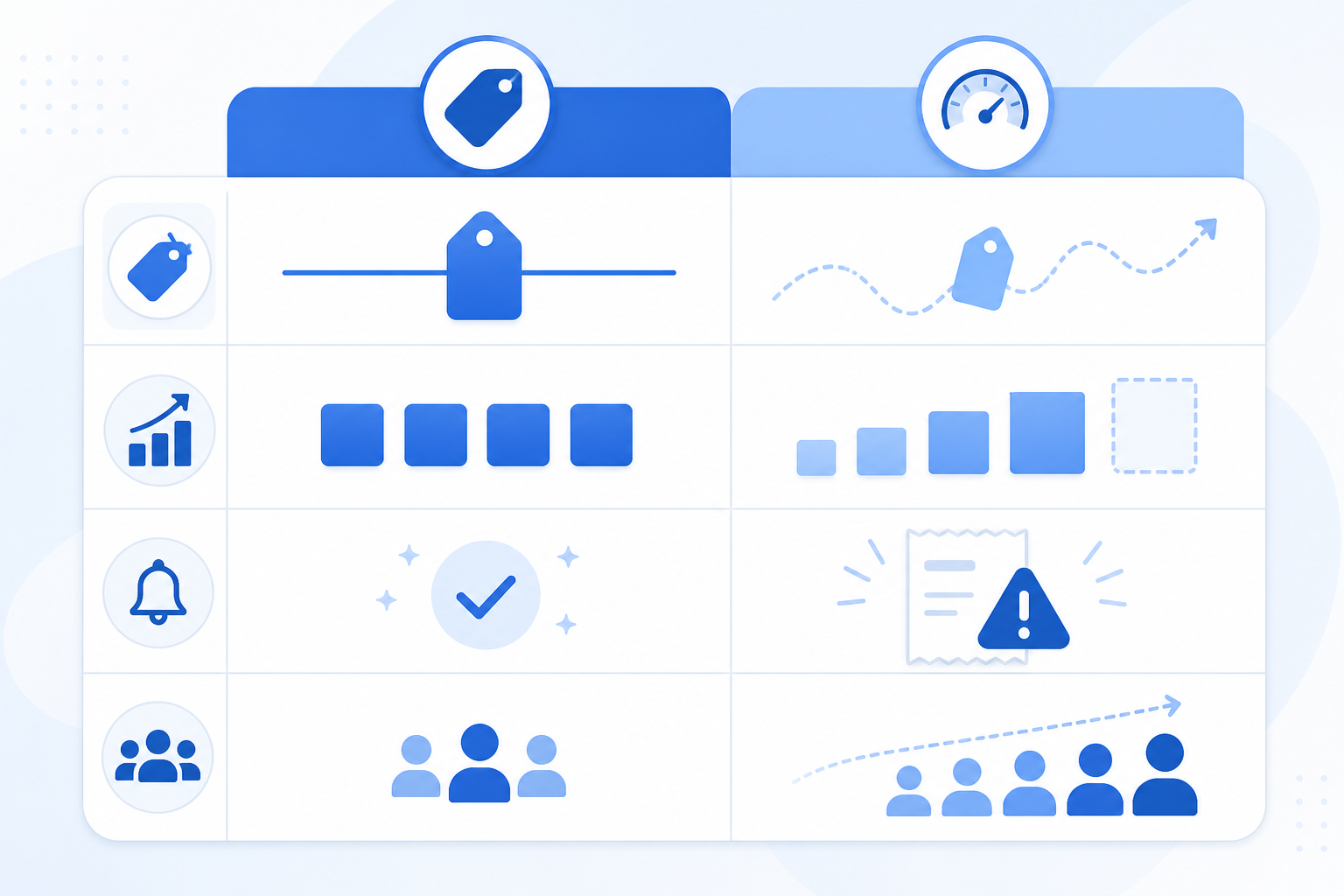
| Factor | Flat-Rate Pricing | Usage-Based / Per-Seat Pricing |
|---|---|---|
| What drives cost | Fixed monthly fee, mostly independent of agents and volume | Agent count, conversation volume, or both |
| Cost predictability | High, same core bill each month | Lower, varies with volume and headcount |
| Scalability | Add agents without extra core cost | Each new agent or volume spike adds cost |
| Billing surprises | Rare on core features, possible on add-ons | Common during growth or peak season |
| Best fit | Growing or seasonal teams | Very small, stable, low-volume teams, or teams on capped or discounted annual plans |
| Budgeting ease | Simple, largely fixed | Requires ongoing monitoring of usage |
Real-world help desk software cost comparison
Numbers make this less abstract, so let's run through a few illustrative scenarios. I'm using a rounded, hypothetical competitor rate of around £31 per seat per month to represent a typical per-seat plan in this category, alongside Sonny's flat rate of roughly £16 a month.
Treat the competitor figures as representative rather than an exact quote from any single named vendor, and always verify current pricing before you budget.
| Scenario | Agents | Monthly conversations | Illustrative per-seat cost | Sonny flat-rate cost | Monthly difference |
|---|---|---|---|---|---|
| Steady small team | 5 | ~800 | £155 | £16 | £139 |
| Growing team, start of year | 5 | ~800 | £155 | £16 | £139 |
| Growing team, end of year | 15 | ~2,400 | £465 | £16 | £449 |
| Seasonal spike, normal month | 8 | 1,000 | £248 | £16 | £232 |
| Seasonal spike, peak month | 8 | 5,000 | £248 + potential overage fees | £16 | £232+ |
A few things jump out here. First, the break-even point arrives almost immediately: because the illustrative per-seat rate (£31) already beats Sonny's entire flat rate (£16) with just one agent, pretty much any team with more than one person will find the flat-rate plan cheaper for the core product, assuming the features are comparable.
Second, the gap widens fast as a team scales. A team growing from 5 to 15 agents over a year would see its per-seat cost climb from roughly £1,860 to £5,580 annualised, while a flat-rate cost stays around £192 a year, a difference of several thousand pounds.
Third, seasonal spikes don't move the flat-rate line at all, while usage-based or capped plans can push costs considerably higher during peak periods, depending on the specific overage terms.
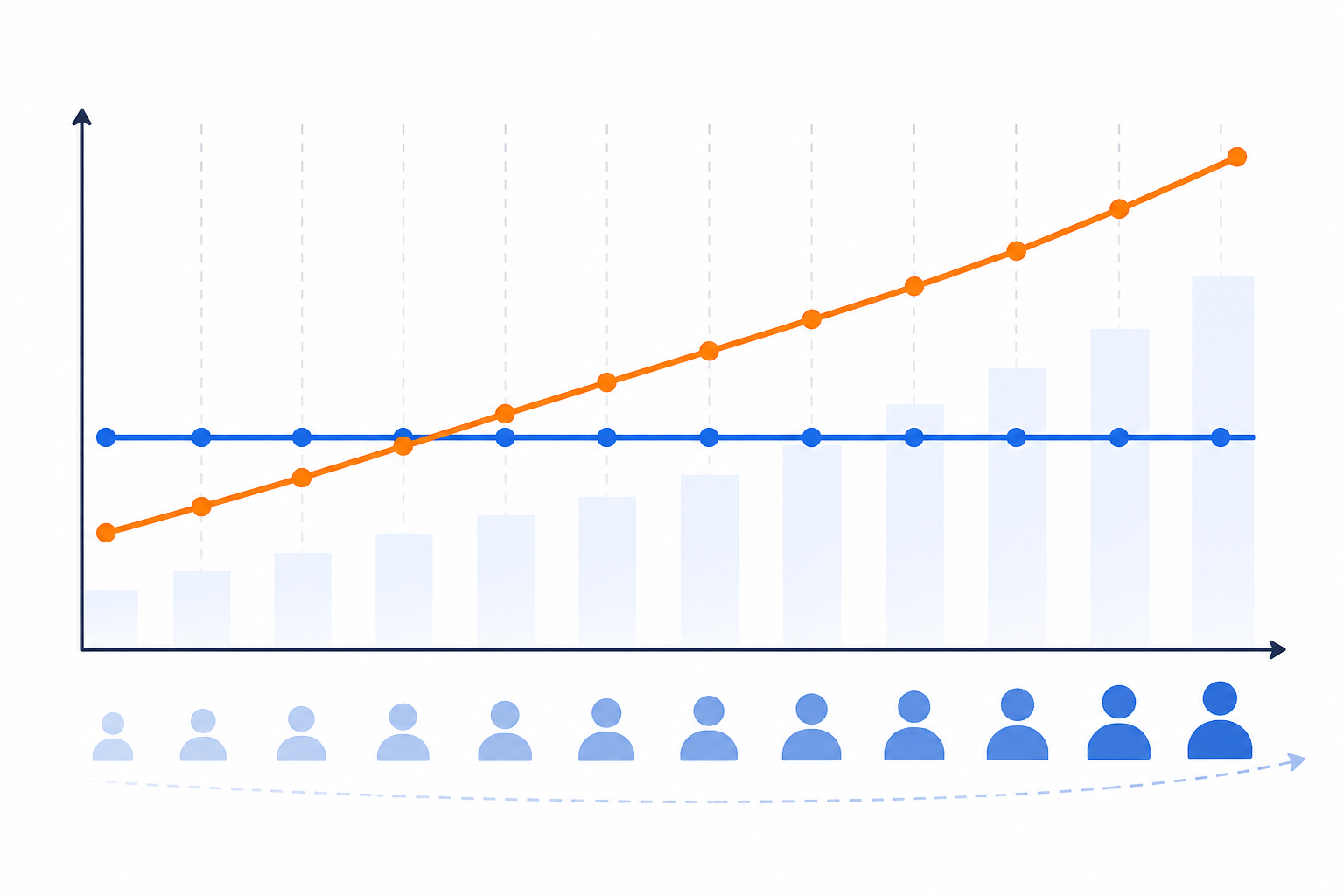
These numbers are illustrative, not a guarantee of savings for every team. If you're comparing real vendors, run the same calculation with their actual published rates, your projected headcount, and your expected conversation volume, including any add-ons you'd realistically need.
Which support software pricing model fits your growth stage?
Not every team is in the same spot, so let's break this down by where you are right now.
- Early-stage startups: flat-rate pricing protects your runway. When cash is tight, knowing your support software bill won't move is genuinely reassuring, even before you've hired a dedicated support agent.
- Scaling teams: unlimited agents mean you don't have to model software costs into every hiring decision. Bring on your sixth or twelfth support rep without recalculating your monthly spend.
- Seasonal or high-volume businesses: unlimited conversations matter a lot here. If your busiest month is several times busier than your quietest, volume-based charges can pile on unpredictable costs exactly when you need support most.
- Teams with genuinely stable headcount and volume: usage-based or per-seat pricing can still make sense, particularly if you've negotiated an annual rate, your volume is locked in, and you've actually run the numbers rather than just assuming things will stay stable.
Ask yourself: do you expect your team size to change in the next 12 months? Does your conversation volume swing with seasons, campaigns, or launches? Have you been burned by a software invoice before? If you answered yes to any of these, flat-rate pricing deserves a serious look.
What to look for beyond help desk software pricing
Price matters, but it's not the only thing worth checking. Add these to your comparison list, and verify each one directly against a vendor's current documentation:
- Setup time and onboarding friction: Sonny's onboarding is built to be fast, with published guidance suggesting you can be up and running in minutes rather than days. Your actual experience will depend on your existing workflows and integrations.
- Uptime and reliability: check the vendor's published SLA and status page history rather than trusting a headline number alone.
- Multi-channel support: look for a genuine shared inbox that combines live chat and email-to-ticket forwarding, so your team isn't juggling separate tools for separate channels.
- Team collaboration features: internal notes, tagging, filtering, and response-time reporting matter more than they seem, especially for a small team trying to stay organised.
- Trial terms: a free trial that doesn't ask for a credit card upfront lets you test the tool with your real team before committing. Confirm the current trial length and terms, since these details shift.
- UK-specific considerations: if you're based in the UK or billing from a UK entity, check whether quoted prices include VAT, what currency you'll actually be billed in, and the contract terms around data processing and cancellation.
Frequently asked questions about flat-rate and usage-based pricing
Is flat-rate pricing better than usage-based billing for SaaS support tools?
Not always, but it's often better for growing or fluctuating teams. Flat-rate pricing tends to win on predictability in nearly every case, and it frequently wins on total cost once a team grows beyond a handful of agents or hits seasonal volume swings.
Usage-based pricing can still be the cheaper option for very small, genuinely stable teams on the right plan tier. Run the numbers for your specific situation rather than assuming one model is always better.
How do I calculate the break-even point between flat-rate and usage-based pricing?
Divide the flat-rate monthly price by the usage-based or per-seat price to see how many agents, or how much volume, it takes for the two plans to cost the same.
For example, if a flat-rate plan is £16 a month and a competitor charges £31 per seat, the two plans cost roughly the same at just over half of one agent. So any team larger than a single person will likely find flat-rate pricing cheaper, assuming comparable features and no major add-on costs on either side.
How do I budget for support software as my team grows?
Start by mapping your expected agent count over the next 12 to 18 months, not just today's headcount. Then run each pricing model against that projected figure instead of your current one.
With per-seat pricing, use your future headcount to estimate future cost. With flat-rate pricing, your core cost stays the same regardless of growth, though you should still budget separately for any add-ons you expect to need.
What are the risks of usage-based support software pricing?
The main risks are unpredictable monthly invoices, overage fees once you cross conversation or ticket caps, and a subtle disincentive to add support agents even when your team genuinely needs them.
Some teams end up understaffing support just to avoid triggering a pricing tier increase, which can hurt customer experience. Checking your actual usage patterns against your plan's limits every few months helps catch this before it turns into a budget problem.
Flat-rate pricing: the bottom line for growing support teams
Choosing between flat-rate and usage-based billing really comes down to one practical exercise: project your agent count and conversation volume 12 months out, then run both pricing models against that projection rather than today's numbers.
If you're planning to grow, expect seasonal swings, or just want fewer variables in your monthly budget, flat-rate pricing belongs on your shortlist. If your team and volume are genuinely stable and you've read the fine print on caps and overage terms, a usage-based plan might still hold its own.
That's the thinking behind Sonny's roughly £16-a-month, unlimited-agent core plan, giving growing and seasonal teams one less number to recalculate every month. Whatever you end up choosing, run your own numbers against current published pricing before you commit. It's a ten-minute spreadsheet exercise that can save you a genuinely unpleasant invoice surprise down the line.