
Shared Inbox vs Multiple Support Tools: A Practical Guide for Small SaaS Teams
Here's the short version: a shared inbox often beats running multiple support tools because it reduces the hidden costs of context-switching, duplicate replies and per-seat pricing that add up quickly for small teams. When live chat, email and internal collaboration all live in one place, your team can respond faster, fewer messages fall through the cracks, and you avoid stitching together several subscriptions to do what one well-chosen help desk software platform could handle.
If you're an early-stage SaaS founder currently bouncing between a chat widget, a shared inbox account and a Slack channel that's slowly becoming your unofficial ticketing system, I get it. It felt manageable when it was just you. It doesn't anymore. Let's look at why — and where a shared inbox genuinely helps, as well as where it may not be enough.
The Hidden Cost of Juggling Multiple Support Tools
Most founders don't set out to build a Frankenstein support stack. It happens gradually. You add a free live chat widget to your site because customers were emailing basic questions. Then someone sets up a support inbox. Then someone else suggests tracking bugs in a spreadsheet. Before long, you've got four or five places where customer conversations can start, and no single place where they all end up.
This isn't just an early-stage problem, either. Salesforce's State of Service research has repeatedly found that service organisations juggle a surprising number of tools to manage customer service — figures around eight to ten different systems appear across different editions of the report. The exact number changes depending on the year and sample, but the trend is consistent: tool sprawl creeps in everywhere, even in well-resourced enterprise teams. If that's true for companies with dedicated operations staff, it's worth asking how quickly a five-person SaaS startup can drift into the same mess without anyone noticing.
Here's what that support tool sprawl actually costs you.
Time lost to context-switching. A well-known set of studies from UC Irvine, led by Dr Gloria Mark, found that after an interruption it can take well over 20 minutes on average to fully return to the original task. It's worth being precise about what that measures: it's the time to resume deep, focused work after being pulled away — not a strict per-app-switch tax. But the underlying point still holds. Picture a support agent checking the live chat widget, then Slack, then the support inbox, then a spreadsheet, dozens of times a day. Even a fraction of that recovery cost, repeated constantly, adds up to real hours of lost focus every week — time you don't have when you're an early-stage team wearing six hats.
Money lost to per-seat pricing. Popular help desk software often charges per agent, which sounds fine until you add a part-time VA, a customer success hire and a founder who jumps in during busy weeks. Suddenly you're paying full price for people who touch support only occasionally.
Customers lost to dropped context. When conversations are split across email, chat and internal messages, customer history gets trapped in someone's personal inbox or a private DM. Zendesk's Customer Experience Trends research has found that a large majority of consumers say they'll spend more with companies that offer a seamless experience across channels, and a comparable share say they'll switch to a competitor after repeated bad experiences. These are self-reported survey figures, so treat the exact percentages as directional rather than precise — but the underlying pattern appears consistently year after year. Missed hand-offs aren't just annoying internally. They're commercially expensive.

What Does a Shared Inbox Actually Solve?
A shared inbox isn't just “email but nicer”. It's a different way of organising how your team handles customer conversations. Here's what changes when you consolidate, and what to watch for as you do.
- One unified view of every conversation — whether it started as a live chat message or an email, it lives in the same place, with the same history attached. This is the core promise, and it's the one worth testing carefully with your own real conversations before you commit.
- Internal notes and tagging so your team can loop each other in on a tricky question without accidentally replying to the customer mid-discussion.
- Clear ownership — you can see who's assigned, what's pending and what's been resolved at a glance, instead of asking “is someone already handling this?” in Slack.
- Built-in reporting on response times and team performance, without manually stitching together numbers from three different dashboards that all define “resolved” differently. Keep in mind that basic shared inboxes usually offer lighter reporting than dedicated enterprise help desks — fine for a small team, but worth checking if you need detailed SLA analytics later.
- Flat-rate pricing (where available) that means bringing on a new support agent — even a part-time one — doesn't automatically require reopening your budget spreadsheet.
This aligns with guidance you'll find from established providers such as Help Scout and Intercom: let your help desk act as the system of record for customer conversations, and keep other tools, such as Slack, for internal team collaboration rather than allowing customer context to disappear in private messages.
When a Shared Inbox Might Not Be Enough
It's worth being honest here: a shared inbox isn't the right fix for every team. If you need complex ticket routing across dozens of departments, deep automation and workflow branching, telephony integration or enterprise-grade compliance reporting, a lightweight shared inbox may feel limiting rather than liberating. Larger support organisations often need the heavier feature set of a full-scale help desk platform. For most small SaaS teams under, say, 15–20 people, though, the simplicity is the point — you're trading advanced configurability for speed and clarity.
Is a Shared Inbox Better Than Separate Chat and Email Tools?
For most small teams, a unified shared inbox is more efficient than separate chat and email tools because it keeps customer history, ownership and internal collaboration in one place. Separate tools can still work for a solo founder with very low support volume, but they tend to create friction as soon as more than one person handles customer conversations.
The right choice depends on your support complexity. A shared inbox is usually a good fit for a small SaaS team managing email, live chat and straightforward customer questions. A full help desk platform may be more suitable if you need advanced automation, complex routing, telephony or detailed compliance reporting.
Live Chat and Email in One Place: A Real Shared Inbox Workflow
Let's walk through a scenario that probably sounds familiar.
A customer visits your site, has a quick question and contacts you through the live chat widget. Your agent answers in real time — great, quick resolution. But then the customer thinks of a follow-up question the next day and, instead of coming back to chat, sends an email instead.
In a fragmented setup, that email lands in a completely different tool. The person answering it has no idea a chat conversation happened yesterday. They ask the customer to explain everything again. The customer, understandably, gets a little annoyed. Nobody did anything wrong exactly — the tools simply weren't built to talk to each other.
With a genuinely unified shared inbox — Sonny is one example that's built around this idea — that same interaction can stay as one continuous thread, matched by the customer's contact details, with the full history visible to whoever picks it up. If the agent needs a second opinion, such as confirmation of a refund policy, they can add an internal note tagging a teammate, resolve the issue and reply to the customer without exposing that behind-the-scenes conversation.
Whichever tool you're evaluating, check exactly how it matches a chat message to a later email. Some platforms do this automatically through a contact record; others rely on the customer replying to the same thread. It's a fair question to ask any vendor during a trial.
This is the kind of workflow that matters most for lean teams — the sort of five-person startup where there's no dedicated support operations person whose whole job is untangling which tool has the latest message. The shared inbox has to do that work for you, because nobody has time to do it manually.

Signs Your SaaS Team Is Ready to Consolidate Support Tools
Not everyone needs to switch tools today. But if a few of these signs sound familiar, it's probably time to take consolidation seriously:
- You're paying for two or more tools that each handle only part of your support workflow.
- Someone on your team asks “did anyone reply to this yet?” more than once a week.
- You've missed a customer message because it landed in a tool nobody checks regularly.
- You're missing your own response-time targets and can't easily tell why, because the data is scattered across tools.
- Onboarding a new support hire takes longer than it should, because they need training on multiple systems just to answer a single ticket.
- You're hesitant to hire more support help because per-seat pricing makes every new person feel like a budget decision instead of a support decision.
If you nodded along to two or three of these, your current setup is quietly taxing your team's time and your company's growth.
How to Migrate to a Shared Inbox Without Losing Conversation History
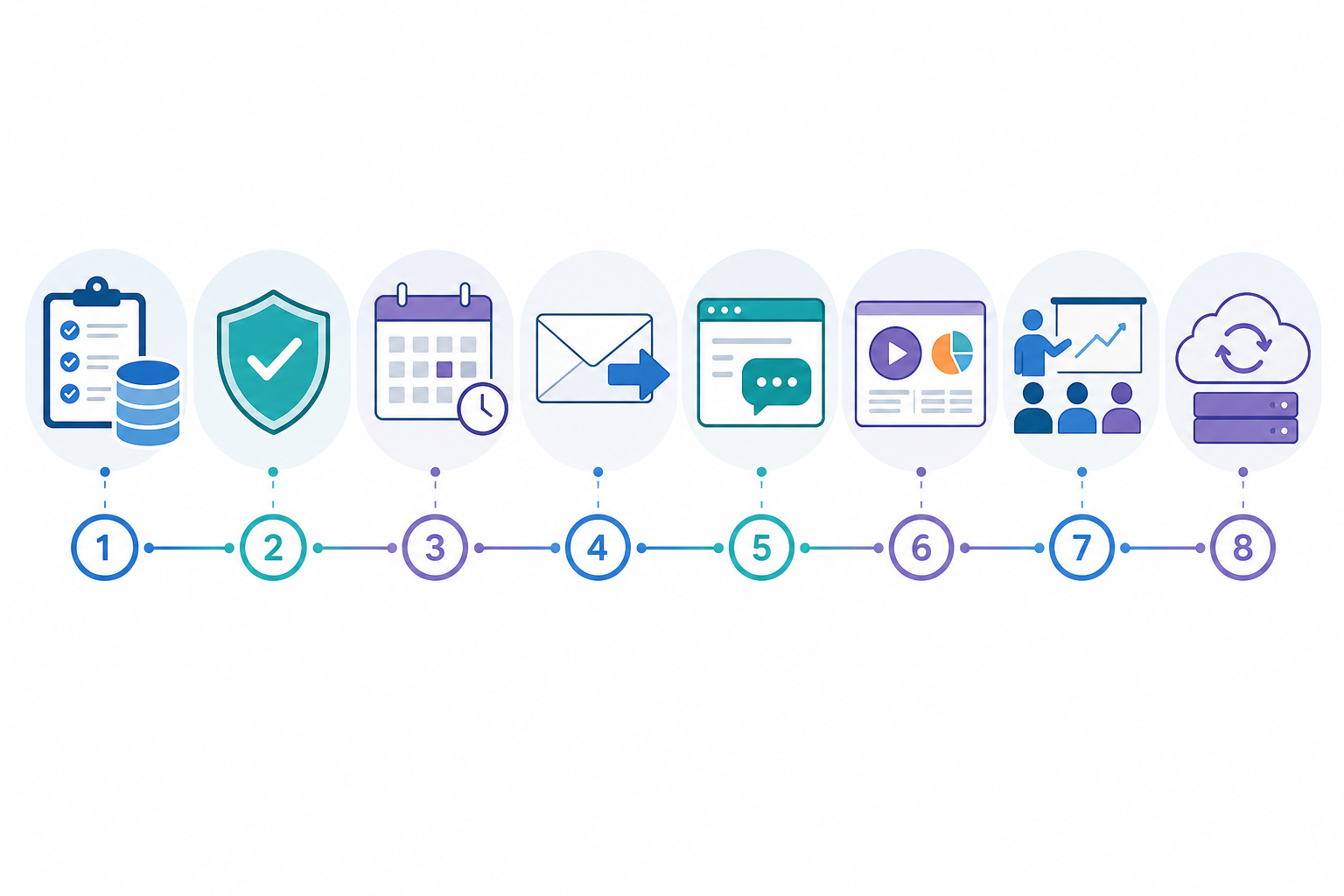
Switching tools takes a little more care than a five-minute setup, but it doesn't have to become a multi-week project if you plan properly. Here's a more complete migration path than simply “export and go”:
- Audit what you actually need to keep. Export or document your existing conversation history from your current tools, including attachments and timestamps where possible. Not every platform imports full email history automatically, so decide upfront what's archived for reference versus what needs to live in the new system.
- Check your data-handling obligations. If you're a UK or EU-based business, confirm how customer data is stored and processed by your new provider, and whether you need to update your privacy notice or data processing agreement. This is a small step that's easy to skip and awkward to fix later.
- Set a cutover date so your team isn't checking two inboxes at once. Ambiguity here is where messages get missed.
- Set up email forwarding rules to route new messages into your shared inbox as tickets automatically, and test with a few dummy messages before relying on it fully.
- Install and test the live chat widget on your site before going fully live, checking that chat-to-email continuity works the way you expect.
- Run a trial with your real team and real conversations, not just a demo. Most shared inbox tools, including Sonny, offer a free trial period — check current terms directly on their site, as these details change.
- Train your team on tagging and internal notes early. Good team collaboration habits are much easier to build from day one than to retrofit later.
- Keep a rollback plan for the first week or two. Don't fully decommission your old tools immediately — keep them accessible in read-only mode until you're confident nothing has been missed.
Why Flat-Rate Pricing Changes the Math for Small Teams
Here's where the numbers really start to matter, and where it's worth being precise rather than persuasive.
Per-seat pricing scales directly with headcount — every person who needs to view, assign or reply to a conversation adds to your bill, regardless of how much support they actually handle. Let's run an illustrative comparison. Figures below are for illustration only — always check current pricing and VAT treatment directly with any provider before deciding:
| Team size | Per-seat plan (~£20/agent/month + VAT) | Flat-rate plan (example: ~£16/month + VAT, unlimited agents) |
|---|---|---|
| 2 people | £40/month | £16/month |
| 4 people | £80/month | £16/month |
| 8 people | £160/month | £16/month |
| 10 people | £200/month | £16/month |
To be fair, flat-rate pricing isn't automatically the cheaper option in every scenario. If you're a two-person team, per-seat pricing might genuinely cost less than a flat-rate plan, especially once you factor in any feature limits on the flat-rate tier. But the moment you cross four or five people touching support, which happens faster than most founders expect, flat-rate pricing tends to start winning. It keeps winning as you grow because your support software bill stops scaling with your headcount.
Before you commit to any provider, UK-based or otherwise, check whether quoted prices include VAT, whether “unlimited agents” comes with any fair-use caps, whether annual billing changes the effective monthly rate, and whether onboarding or migration support costs extra. These details vary by vendor and change over time, so treat any specific number you see, including the ones above, as a starting point for your own comparison rather than a final figure.
This matters most for early-stage SaaS teams because your support load rarely comes from one dedicated person. It's the founder answering a chat at 9pm, a part-time VA handling routine emails during the day and a customer success hire stepping in as things grow. Per-seat pricing tends to penalise exactly that kind of flexible, all-hands support model — the one most early-stage teams actually run on.

Shared Inbox FAQs for Small SaaS Teams
Is a shared inbox better than separate chat and email tools?
For most small teams, yes, with a caveat. A shared inbox keeps every customer conversation, whether it started as a live chat message or an email, in one place, so nothing gets lost and your team isn't duplicating work. Separate tools can work well for a very early solo founder, but they start creating friction the moment more than one person handles support. If your support needs are genuinely complex, involving multiple departments, heavy automation or telephony, a full help desk platform might serve you better than a lightweight shared inbox.
How much time do teams lose switching between support apps?
It's hard to put an exact number on this, and you should be sceptical of anyone who gives you one with false precision. The most commonly cited research from UC Irvine measures how long it takes to fully resume focused work after an interruption, which regularly comes out well above 20 minutes. That's not the same as a fixed cost per app switch, but it's a reasonable proxy for the attention tax that occurs when a support agent has to check four different tools throughout the day. For a team fielding dozens of conversations daily, even a conservative estimate adds up to meaningful lost focus every week.
What features should a shared inbox have for a small team?
At minimum, look for a live chat widget, email-to-ticket forwarding, internal notes for team collaboration, tagging and filtering to organise conversations, and basic reporting on response times. Flat-rate pricing with unlimited agents is a real plus for early-stage teams that expect to grow without their support software bill increasing in lockstep. If you anticipate needing advanced automation or compliance features later, ask each vendor whether its roadmap covers them or whether you'll need to migrate again.
Can I migrate my existing email support history into a shared inbox?
Most shared inbox platforms support email forwarding, so new messages flow into your unified inbox going forward. For historical conversations, export or archive them from your old tool before switching, since not all platforms import full email history automatically. Confirm the process directly with your chosen provider rather than assuming.
What are the main limitations of a shared inbox compared with a full help desk platform?
Shared inboxes typically trade some depth for simplicity. You'll usually get lighter automation, more basic reporting and fewer integrations than with a dedicated enterprise help desk. For teams under roughly 15–20 people handling relatively straightforward support volume, that trade-off tends to be worthwhile. Larger or more complex support operations may outgrow a shared inbox and need to move to a more configurable platform.
Final Thoughts: Is a Shared Inbox Right for Your Team?
If your team is spending more time managing tools than managing customers, that's usually the clearest sign it's time to consolidate. A shared inbox won't solve every support challenge overnight, and it isn't the right fit for every team's complexity, but for most early-stage SaaS teams it removes the friction that's quietly costing you time, money and the occasional dropped ball.
Whatever tool you choose, run a proper trial with your real conversations, check the pricing details — including VAT — that actually apply to you, and give your team a fair chance to build good habits before judging the switch. That's a more honest test than any five-minute setup promise.